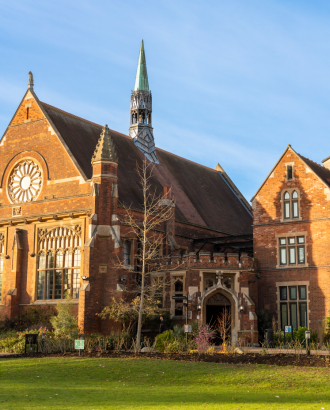
Homerton College is delighted to welcome its eleven newest Fellows, following the Fellows Swearing-In ceremony of 5th October 2026.
Honorary Fellow

Professor Jane Anderson CBE
Professor Jane Anderson CBE has spent her working life in London, and has cared for people living with HIV since the earliest days of the epidemic in the 1980s.
She is a Consultant Physician in HIV Medicine at Homerton University Hospital in Hackney, where in 2004 she set up the Centre for the Study of Sexual Health and HIV, which she directs. So the name Homerton is already a familiar one to her.
Her work has focused on the needs of ethnic minority and migrant communities affected by HIV in this country, with a particular interest in care for women and families.
Since 2016, she has chaired the National AIDS Trust, and she jointly chairs the leadership group of Fast-Track Cities London. She is a past chair of the British HIV Association, holds honorary academic appointments at Barts and the London School of Medicine and Dentistry and at University College London, and was appointed CBE in 2015.
Fellows

Professor Michaela Benson
Professor Michaela Benson is Professor of Sociology here at Cambridge, a Chair she took up on 1st October after being unanimously elected to it. Its previous holders include Anthony Giddens, so she is in good company.
Before joining Cambridge she was Professor in Public Sociology at Lancaster University. She is internationally recognised for her work on migration and citizenship, including Brexit and migration, lifestyle migration, class, space and place, and self build housing. Her research has informed policy discussions in the UK and the EU, and in 2025 she was made a Fellow of the Academy of Social Sciences.
Her books include The British in Rural France and Lifestyle Migration and Colonial Traces in Malaysia and Panama, and since 2022 she has been Chief Executive of The Sociological Review. She also makes sociology accessible well beyond the academy, including through her podcast, Who Do We Think We Are?, which looks at race, identity and belonging in Britain today.

Dr Andrew Catherall-Ostler
Dr Andrew Catherall-Ostler read Natural Sciences here at Homerton, went on to a PhD in evolutionary biology at Christ’s, and was elected a Bye-Fellow of this College in 2023.
Andrew is a College Lecturer teaching evolutionary biology to our second and third year students, and an Undergraduate Tutor. His research looks at the role of circular genetic codes in evolution and at how cellular network theory can be applied to evolutionary biology.
He also helped found the Cambridge Biology Challenge, a national competition that encourages school students to see biology as a subject in which there is as much to think about as there is to remember. He lectures widely for the University’s Institute of Professional and Continuing Education.

Dr Álvaro López-Acosta
Dr Álvaro López-Acosta is a Research Associate in the Departments of Biochemistry and Chemistry, where he builds synthetic molecular systems that mimic living processes.
At Cambridge he studies how light, particularly ultraviolet radiation, affects lipid membranes, the protective compartments of life. Understanding how those membranes survive extreme conditions matters for the search for life on other planets, for growing food on future space missions, and for creating new materials such as artificial organs.
He holds a PhD from the University of Strasbourg, and his research has taken him to the UK, France, Germany, Israel and Spain, including the Weizmann Institute of Science and the Max Planck Institute for Polymer Research.
Beyond the lab he is an accredited public speaking trainer, a trained Mental Health First Aider, and has led international volunteer expeditions with Raleigh International in Costa Rica and Tanzania. In his spare time he dances salsa and is training for his private pilot’s licence.

Ms Katy McCulloch
Ms Katy McCulloch joins us as a Fellow working in Late Antiquity.
Her doctoral research in the Faculty of Divinity looks at the ideal of consensus in the debates and proceedings of the general church councils of the fifth century: how consensus was understood, how it was pursued, and how it was received.
Her next project explores how Syrian Orthodox Christians negotiated their own religious and linguistic traditions during the Christological debates of the early sixth century, and the part that translation played in that story. Her work plays a role in opening up dialogue today between Chalcedonian and non Chalcedonian church traditions.

Dr Melina Seabrook
Dr Melina Seabrook is an archaeologist who puts animals at the centre of how we understand the growth of the first cities in southwest Asia.
She took her BA in Anthropology at Stony Brook University, then her Master’s and PhD at Harvard, where she studied the sheep and goats of Tepe Yahya in Iran using archaeological science methods. She brings together zooarchaeology, archaeological science, imagery and ancient texts.
This year she was named a Renfrew Fellow at the McDonald Institute for Archaeological Research. Her project, Sumer by the Sea, will be the first systematic study of marine species in the ancient cities of Mesopotamia, and asks what part the sea played in the foundations of urban life.

Dr Izzy Wisher
Dr Izzy Wisher is an archaeologist who asks why our ancient ancestors made art, and what part it played in their lives.
Her current research focuses on the period after the last Ice Age, when volatile climates and changing populations coincided with a dramatic shift in artistic traditions, from the animal paintings of caves such as Lascaux and Altamira to small geometric patterns engraved on bone and stone.
She did her PhD at Durham, using Virtual Reality eye tracking and lighting reconstructions to understand how flickering firelight may have shaped the making of cave art. From 2022 she was a postdoctoral researcher at Aarhus University in Denmark, on a European Research Council project on the evolution of symbolic behaviour. Izzy is also a gifted communicator, who has appeared on BBC Radio 4’s You’re Dead to Me and NPR’s Science Friday, and writes for Aeon magazine.
Bye-Fellows

Ms Shanna Hart
Ms Shanna Hart is our Music Administrator, and many of you will already know her from the music life of this College.
Before taking up her current role, she was Homerton’s first ever Assistant Organist, from 2021 to 2023, playing for the Charter Choir as it returned to regular services and concerts after months of restrictions.
Shanna was Organ Scholar at Selwyn as an undergraduate and went on to play for Robinson College and St John’s Voices. She attained her FRCO in 2019, was a semi finalist in the IAO and RCO Organ Playing Competition in 2022, and sits on the committee of the Society of Women Organists. She also supervises counterpoint, fugue and practical musicianship for the University.

Dr Jessica Patterson
Dr Jessica Patterson is Lecturer in the History of Political Thought in the Faculty of History, and a historian of eighteenth and nineteenth century political thought, with a particular focus on enlightenment and empire.
She took her first degree in History here at Cambridge, then an MA at Queen Mary and UCL, and an AHRC funded PhD at Manchester, where she was a President’s Doctoral Scholar. She held posts at Queen Mary and King’s College London before joining the Faculty in 2020.
Her book, Religion, Enlightenment and Empire: British Interpretations of Hinduism in the Eighteenth Century, won the Constance Blackwell Prize in 2022. Her latest project explores how Britain’s turn to empire shaped British radical political thought between the 1780s and the 1820s.

Dr Tom Scriven
Dr Tom Scriven is a historian of modern Britain, with a particular interest in the political thought and culture of working class people during the long nineteenth century.
His first book, Popular Virtue: Continuity and Change in Radical Moral Politics, 1820 to 1870, was published by Manchester University Press in 2017 and traced how radical political culture changed during the Chartist era. He has recently completed his second, Unreal Freedom: Slavery, Race, and Working-Class Radicalism in Britain, 1830 to 1874, which shows how working class radicals moved from an apologetic position on slavery in the British Empire and America to fully embracing abolition.
His interests also include Black British history in the early Victorian period, and he has written for Tribune on William Cuffay, the Black leader of the Chartists. He is a historian of Parliament and elections too, and since 2019 has contributed to the History of Parliament’s House of Commons project covering 1832 to 1868. Before coming to Cambridge he worked at Oxford Brookes University and the University of Manchester.
Tom and Jessica Patterson are also writing together on Old Corruption and critiques of the East India Company. So today we welcome a partnership as well as two Bye-Fellows.
Associate Fellow

Professor Diego Lazzarich
Professor Diego Lazzarich is Professor of the History of Political Thought at the University of Naples “L’Orientale”.
His work focuses on two themes: war, in the early modern law of nations and in modern political discourse, and gratitude as a political obligation across the Western history of political thought. He is the author of three books, and is now completing a book in English on gratitude and ingratitude in early modern and modern political thought.
He has held visiting positions at universities across Europe, the Americas and Australasia, and this year holds a Fulbright Distinguished Chair at Northwestern University. He is founder and editor in chief of the journal Politics. Rivista di Studi Politici, and serves on the advisory boards of the Association for Global Political Thought at Harvard and the Italian Association for the History of Political Thought.